Family & Culture

Raising a Bicultural Family: The Benefits and Joy of Cross-Cultural Homes

A bicultural family blends two languages, two sets of traditions and two ways of celebrating the same holidays into one household. For American men building a life with a European partner, that blend becomes the everyday rhythm of raising children - bedtime stories in two languages, grandparents on two continents, and a family identity built on more than one culture.

Two Cultures Under One Roof

Every bicultural family starts the same way: two adults from different countries decide to build a life together. What follows is a household where a child's first words might come in English and a European language at once, where Sunday dinner borrows recipes from two kitchens, and where a passport photo album spans two continents before a first birthday.

None of this happens by accident. It takes deliberate choices about language, travel and how much of each culture stays visible in daily life - choices that usually begin with a serious relationship formed on a platform like our European dating platform, where both partners already know they want a family, not a fling.

Couples who meet through German dating or similar regional connections often ask the same practical questions: which language comes first, how holidays get split between two families, and whether a child raised between two cultures ends up confused or simply better equipped.

The honest answer is that bicultural children tend to gain more than they give up - provided both parents treat the second culture as a daily habit, not an occasional souvenir reserved for holidays.

The Direct Answer

What Are the Benefits of Raising Bicultural Children?

Raising bicultural children gives them two languages, two extended families and an early habit of moving comfortably between different social worlds - advantages that tend to compound rather than create confusion.

Two Languages From Day One

Children raised in a two-language household absorb grammar and vocabulary the way any child absorbs a first language - through daily repetition, not homework. Families connecting through German dating often start this habit early, with one language spoken at home and the community language everywhere else.

  • Native-level pronunciation in both languages
  • Stronger working memory in early school years
  • A head start on any third language learned later

Wider Family and Wider World

A bicultural child inherits two sets of grandparents, cousins and holiday traditions instead of one. Couples who meet through French dating describe summers split between a home in the United States and a village outside Lyon as simply the norm, not a special trip.

  • Regular contact with extended family on two continents
  • Comfort with travel and new places from an early age
  • A wider circle of adults invested in the child's upbringing

Flexible Thinking and Confidence

Switching between languages and customs before school age builds a habit of reading context and adjusting quickly - a skill that shows up later at school and at the dinner table. Families formed through Italian dating often see it first at holiday gatherings, when a child moves easily between two sets of expectations.

  • Early recognition that more than one "normal" exists
  • Faster development of social perspective-taking
  • A natural comfort with cultural difference later in life

Daily Habits

Keeping Both Cultures in Balance

Balance rarely happens on its own. Couples who keep both cultures visible tend to rely on the same small set of routines, repeated often enough that no one has to think about them.

  • One Parent, One Language Each parent consistently speaks their own native language with the child, so both languages develop as first languages rather than one lagging behind.
  • Alternating Major Holidays Christmas, Easter or Thanksgiving rotate between American and European traditions each year instead of defaulting to whichever parent is local.
  • An Annual Trip to Her Home Country A yearly visit keeps grandparents, cousins and the language itself part of daily life rather than something reserved for special occasions.
  • Regular Video Calls With Grandparents A short weekly call keeps the second language spoken casually, not just practiced from a textbook.
  • Food From Both Kitchens Recipes from both sides of the family appear on an ordinary weeknight, not only for holidays or guests.
  • Bilingual Bedtime Stories Reading in both languages before bed builds vocabulary in a low-pressure setting children actually look forward to.
  • Letting Children Choose Their Own Blend As children get older, they decide how much of each culture to carry forward - the goal is comfort with both, not a forced split.
  • Marking Both National Holidays Acknowledging both countries' celebrations keeps neither culture feeling like the guest in the household.

Composite Example

One Family's Everyday Rhythm

An anonymous composite drawn from the patterns support hears most often. No names, no figures.

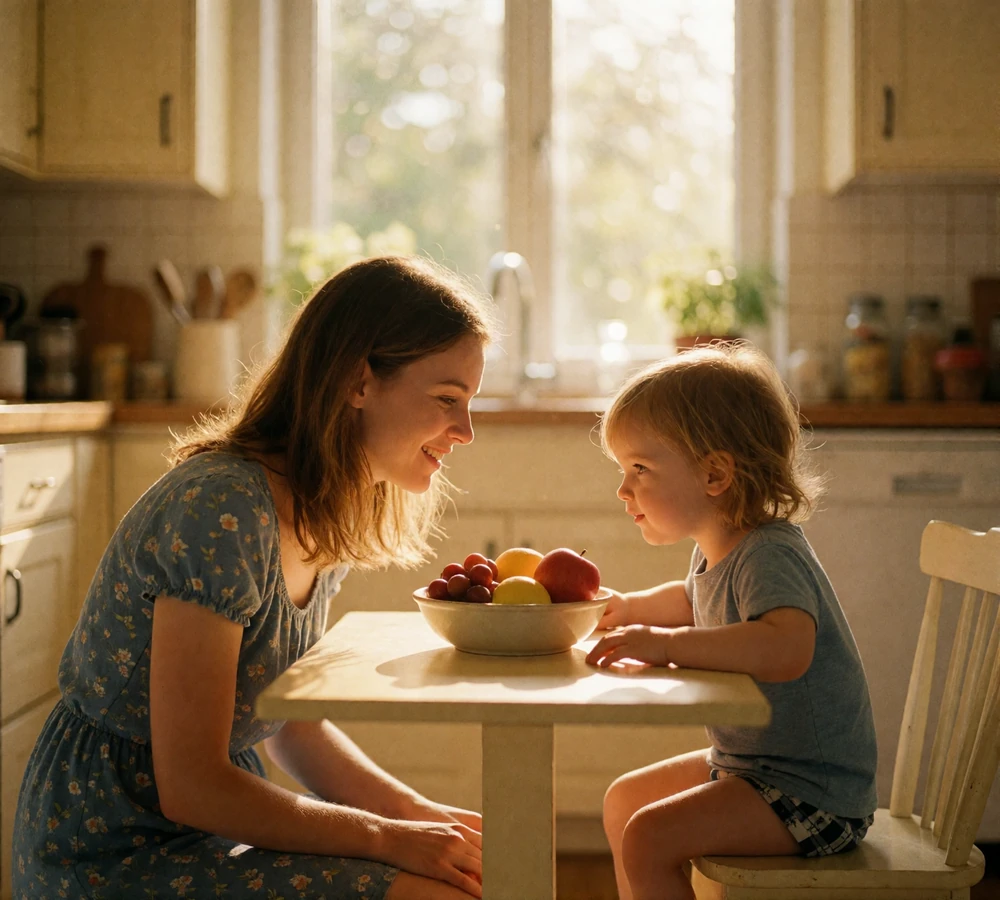
European mother kneeling beside her young child at a sunlit kitchen table, smiling over a bowl of fresh fruit
Our daughter switches languages mid-sentence and doesn't even notice she's doing it.

In one composite household, mornings start in two languages before the coffee finishes brewing. The father speaks English over breakfast; the mother answers their daughter in her native language without missing a beat, correcting a verb ending as easily as buttering toast. Neither parent treats it as a lesson. It is simply the way the family talks.

Saturdays alternate between a diner near his parents' house and a video call with hers, where the child performs whatever new phrase she has picked up that week for an audience across the Atlantic. Twice a year the whole family flies to her home country, and the child slides back into the local rhythm within a day or two - a different school, a different playground, the same grandmother's kitchen.

The parents did not plan every detail in advance. They agreed early that each of them would speak their own language at home, that holidays would rotate rather than default to whichever culture felt more convenient, and that the child would eventually decide for herself how much of each identity she wanted to carry forward. What surprised them was how little friction it created - the bicultural household turned out to be less a compromise than a second, quieter kind of abundance.

Go Deeper

Related Articles

Two follow-up guides for couples thinking through the cultural expectations and shared values that shape a bicultural household.

The Bottom Line

Raising a bicultural family means saying yes to complexity in exchange for genuine abundance: two languages, two extended families, and children who grow up comfortable moving between different worlds. The practical work - one parent, one language, alternating holidays, regular trips home - becomes straightforward once it turns into routine. For a fuller look at how cultural expectations shape these households before children even enter the picture, read our guide to European family traditions, and for the deeper question of what actually holds a cross-cultural couple together, see shared values versus shared culture. If you are still early in the process, the first step is the same one every bicultural family took: meeting a partner whose intentions match your own.

Meet a Partner Who Wants the Same Bicultural Life

Every bicultural family starts with two people who want the same future. Create a free profile, verify your identity and start real conversations with European women who share your intent to build a family across two cultures.

  • Verification before contact
  • 28 nationality categories
  • No card details at signup